
Education and teaching
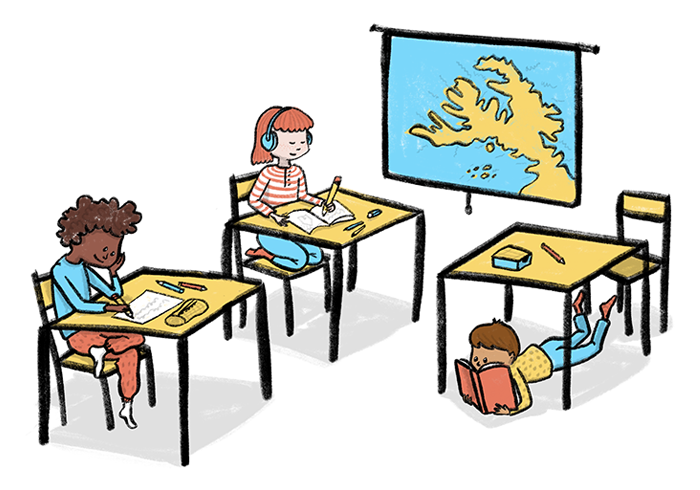
Reykjavík City primary schools follow the national curriculum for primary schools, with reference to the Reykjavík City Education Policy. The main objective of the Policy is for all children to grow, develop and feel happy in a democratic society that is based on human rights and respect for the diversity of human life.
Through robust school and recreation activities, children and young people gain education and experience to realize their dreams and have a positive impact on their environment and society.
Learning at Hagaskóli
Students at Hagaskóli engage in diverse subjects. The curriculum primarily includes these academic subjects for all three years: Icelandic, mathematics, English, Danish, natural sciences, social studies and well-being. Additionally, creative and practical classes are taught in grade 8, and students in grades 9 and 10 can choose from a wide range of electives.
Hagaskóli emphasizes quality teaching with diverse teaching methods that are suitable for all students.
Curriculum plans
Students and parents can find the general section of each subject’s curriculum plan on Mentor.
See below for what students cover in each learning period. The same information is available in each grade’s learning path.
- Grade 8 curriculum plans (coming soon)
- Grade 9 curriculum plans (coming soon)
- Grade 10 curriculum plans (Icelandic, mathematics, English, Danish, and social studies/natural sciences)
Information about school operations
Mentor is an information system for students, parents and school staff. Guardians and students receive a Mentor password. On the family page, guardians can see:
- class schedules
- curriculum plans
- homework
- educational assessment results
- school attendance
Students are assigned a password to access student pages.
From pixels to paper
In our daily academic work at Hagaskóli, we generally use books and paper, writing with a pencil or pen. We deliberately use these methods for reading, taking notes, working through material, and practicing to create space for concentration and reflection. Discussions, hands-on work, and direct interaction between teachers and students also play a key role.
We use digital technology when it serves a clear educational purpose and supports learning goals. Teachers determine when devices are used. This protects students' focus and maintains an environment where they can work without disruption. Students who need digital support, such as text-to-speech or speech recognition, receive appropriate assistance and access to assistive technology.
Educational assessment
At Hagaskóli, efforts are made to use educational assessment that guides the student and allows them to see at any time where they stand in their studies.
Student exam grades are based on assessments of diverse projects completed throughout the school year. Detailed descriptions of assessment methods for each subject are in the lesson plans on Mentor.
Teaching methods
Hagaskóli is implementing formative learning. The main goal is to enhance students' learning awareness, resilience, and growth mindset.
Teaching aims to help students gain skills and knowledge that promote continuous education and development. The school lays the foundation for independent thinking and trains students' ability to collaborate and pursue further education and future careers
School attendance guidelines
The school emphasizes student punctuality. All children and young people aged 6 to 16 must attend school, and parents/guardians are responsible for their primary school enrollment, attendance, and participation.
If school attendance issues arise, parents/guardians and the school must respond. To ensure effective responses, Reykjavík's primary schools follow unified guidelines and rules.